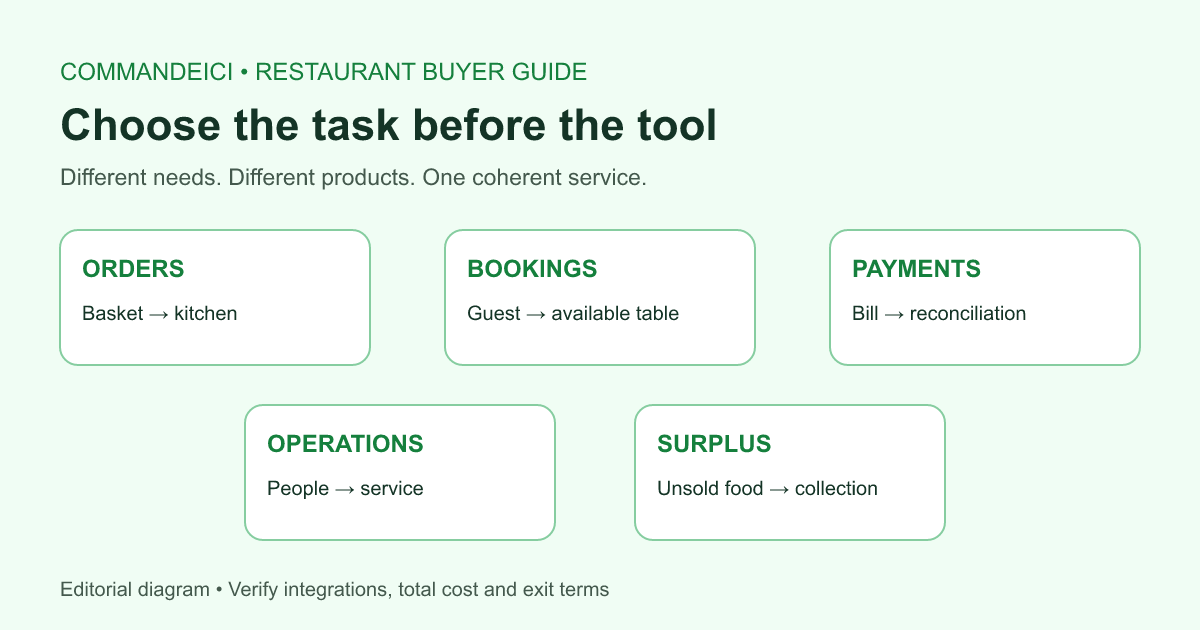
For a restaurant in France, a useful foodtech shortlist starts with Zenchef and TheFork Manager for bookings, sunday for table payments, Innovorder and Zelty for ordering and operations, and Too Good To Go for surplus food. Skello addresses staff scheduling, while commandeici is an option to evaluate for direct online orders. These products solve different problems: there is no single winner across all eight.
This guide is for an English-speaking owner, manager or buyer choosing technology for a restaurant operating in France. It covers products marketed to restaurants, rather than ranking food manufacturers, agricultural research ventures or investment opportunities. “Best” means suitable for your service model, existing equipment and budget, with limitations you can check before signing.
Editorial disclosure: commandeici publishes this guide and sells a direct-ordering service included below. The selection is based on public product documentation checked on 11 September 2026, not hands-on testing of every platform, negotiated quotes or measured customer results. Company claims establish advertised functionality; they do not prove better profitability. Product availability and contract terms need confirmation for your establishment.
Contents
- What counts as restaurant foodtech?
- Shortlist by restaurant need
- Eight providers to investigate
- Build the smallest useful stack
- Compare the full cost
- Run a useful demonstration
- Check data and exit terms
- Plan a controlled pilot
- FAQ
What counts as restaurant foodtech?
Foodtech covers a much wider industry than restaurant software. DigitalFoodLab’s definition groups innovation into agriculture, food science, foodservice, consumer technology, delivery and supply chain. A company producing a new ingredient and a company taking restaurant reservations can both belong to that ecosystem without competing for the same purchase.
Our scope is narrower: technology an operator can assess for running or selling food from a restaurant in France. We include businesses serving that market, including international providers. Inclusion does not mean that every company is French-founded, French-owned or exclusively hosted in France. Those are separate procurement questions, particularly for a group with ownership or hosting requirements.
A useful distinction is between software, which helps you operate your own channel, and a marketplace, where customers discover and transact with participating businesses. Some providers combine both. Another distinction is between taking an order and transporting it. An online checkout may arrange neither riders nor insurance nor customer acquisition. Ask exactly which parts of the journey the contract supplies.
Keep lists current. Just Eat Takeaway.com announced that its final day operating in France was 9 December 2024. A 2026 France shortlist that presents its former local offer as an available option needs rechecking. A familiar brand name alone is not evidence of current service in your postcode.
Shortlist by restaurant need
The table is a starting point for enquiries, not a scored league table. The questions in its last column are our suggested procurement checks, not claims that a particular provider lacks the feature.
| Need | Providers to investigate | Question that decides fit |
|---|---|---|
| Direct online orders | commandeici, Innovorder, Zelty | How does a paid order reach the kitchen? |
| Reservations and table management | Zenchef, TheFork Manager | Which booking sources and charges are included? |
| Paying at the table | sunday | Does the exact till integration support your service? |
| Connected ordering and operations | Innovorder, Zelty | Which modules, equipment and support are in the quote? |
| Staff scheduling | Skello | Can the exported hours be checked against your payroll process? |
| Selling genuine surplus | Too Good To Go | Can collection work without disrupting service? |
Choose the row before the company. If staff are copying orders between screens, reservation software will not remove that task. If diners cannot find your booking page, replacing the kitchen printer might improve reliability but leave the demand problem untouched. Write down the failure you want to fix in one sentence before requesting demonstrations.
Eight providers to investigate
Zenchef: reservations and the guest journey
Zenchef’s booking product advertises reservation management, booking reminders and commission-free guest bookings. Its plans page separates packages, so confirm which functions and messaging allowances belong to your quote. “No commission” should not be read as “no subscription”.
Consider it when your main task is organising reservations and service capacity. For a demonstration, use a real seating constraint: two tables that can combine, a terrace that might close, or staggered sittings. Ask the supplier to show how a change reaches the team. Confirm cancellation, deposit and reminder settings before putting them in front of guests. This is a buying scenario, not a result we have measured with Zenchef.
TheFork Manager: booking software linked to a discovery platform
TheFork Manager’s French product page describes reservation management alongside visibility through TheFork’s consumer network. That combination is relevant when a restaurant wants both a booking workflow and access to diners searching on a platform.
Consider it when discovery is part of the requirement, not merely maintaining a diary. Ask for the cost treatment of bookings from your own website, the marketplace and any connected partners. Separate software charges from acquisition charges in the quote. Track whether guests are new to your business before attributing every platform booking to incremental demand. Do not assume a booking you could already have received directly creates the same value as a genuinely additional table.
sunday: payments and ordering around the table
sunday’s official site presents QR payment and ordering products. That makes it relevant to the point in service when a guest wants to pay or place an order, rather than automatically making it a substitute for a reservation or kitchen system.
Consider it when the payment experience is the problem you can observe. Ask to see a split bill, a refund and a guest who prefers not to use a smartphone. Request the precise payment fees and any guest-facing charge for your proposed France contract. Check compatibility with the exact till version and hardware you operate. An advertised integration or a familiar payment logo is only the start of that verification.
Innovorder: connected ordering and restaurant operations
Innovorder’s online-ordering documentation covers on-site ordering, takeaway and delivery within its wider restaurant system. Its positioning makes it a relevant enquiry where several ordering channels need to connect with operations.
Consider it when you want to reduce disconnected steps across ordering and production. Ask for a quote that identifies each component: software, installation, equipment, payment services and support. During the demonstration, follow one item with an option change through checkout and into the kitchen. Establish which system controls availability. A broad product catalogue can be useful, but buying the whole catalogue is not evidence that your particular workflow will be simpler.
Zelty: orders and payments across points of sale
Zelty’s official product site presents tools for restaurant orders, payments and managing points of sale. It is a useful candidate to investigate when the operational centre of the decision is the till and the way channels connect around it.
Consider it when you need to examine shared menus, branch operations or links between sales channels. Ask what a manager can change centrally and what a local team can override. Have the supplier explain the consequences of changing a product name, price or availability in more than one place. Confirm the modules included in the proposed installation rather than assuming every function on the website belongs to the base offer.
Skello: staff scheduling adjacent to the foodtech stack
Skello’s scheduling product focuses on planning teams, including time slots, roles and breaks. This is workforce software used alongside restaurant systems, rather than a food-ordering platform.
Consider it when building rotas and handling changes consumes more attention than the sales workflow. Trial it with the roles and working patterns you actually use. Ask a manager to process a shift change and inspect what reaches the employee and the person preparing payroll. Check records before relying on an export. Software configuration does not remove the employer’s responsibility to verify the rules that apply to staff; we are not assessing employment-law compliance for a specific installation.
Too Good To Go: a separate outlet for surplus food
Too Good To Go’s French marketplace page describes selling unsold food through baskets that customers collect. It belongs in the surplus-food part of the decision, rather than being treated as an equivalent to a full-price takeaway ordering page.
Consider it when there is genuine, recurring surplus and a practical collection window. Ask for current business charges and cancellation conditions. Think through who packs the food, what information the customer needs and how collection interacts with closing. Judge a trial against what would otherwise have happened to those items. Preparing extra food specifically to feed a discount channel changes the economics and should not be counted as recovering existing waste.
commandeici: direct online ordering
Commandeici is currently free for everyone, with no subscription or Commandeici commission. Create your menu and options, share your link or QR code, and receive orders in your dashboard. Customers pay the restaurant.
Consider it when your requirement is a direct ordering channel for people you can bring to your restaurant’s page. Verify menu options, opening times, the receiving device and the handover to the kitchen against your needs. Do not assume that direct-ordering software supplies a discovery audience, drivers or a connection to every till. For a first look, open the commandeici demo and compare the journey with your current process.
Build the smallest useful stack
A restaurant does not need one subscription from every row. The right first purchase is often the one that removes a specific repeated failure while leaving the rest of the service stable. Start with the devices and contracts you already have. An existing provider may offer an adequate module, although its total cost and portability still deserve scrutiny.
For a small takeaway, trace the route from menu to paid order to collection. Can staff pause ordering when the kitchen is full? Can a customer understand when to arrive? How does an unavailable item stop being sold? Adding another channel before those questions are answered can produce more interruptions rather than more useful sales.
For a table-service bistro, separate managing seats from taking payment. The reservation tool needs to represent actual capacity; the payment tool needs to fit the end of service. Neither replaces a clear policy for walk-ins or guests who prefer a conventional interaction. A working fallback is part of good service design.
For a small restaurant group, establish who owns each piece of information. A centrally managed menu can still need local availability controls. A finance team may need consistent reports while managers need branch-level access. Write a permissions matrix before requesting a group quote, so a polished demonstration does not conceal unsuitable access rules.
If you also need broader business context, our English restaurant articles cover adjacent topics. Keep the software shortlist separate from any decision about opening a venue, choosing delivery marketplaces or forecasting the restaurant market. Those decisions involve different evidence and should not turn this guide into an all-purpose business plan.
Compare the full cost
Compare the same work on both sides. A commission may fund discovery, logistics and support, while a software subscription may cover only the ordering interface. Conversely, paying for an audience does not prove that all its orders are additional. Ask what you receive and what you still have to organise.
Use a worksheet with separate lines for subscription, installation, hardware, processing, per-order or per-booking charges, messaging, delivery, support and cancellation. Record whether each figure includes tax and whether it is a promotional price. Do not mix a tax-inclusive sales total with charges calculated on a different base without an explanation from the supplier or your accountant.
Illustrative arithmetic, not a vendor quote: suppose a tool costs €80 per month and €240 to install. Spread the installation over a proposed twelve-month evaluation: that adds €20 per month, making €100 before other charges. If it handles 400 orders, the allocated software and installation cost is €0.25 per order. At 100 orders, it is €1. Payment processing, delivery, packaging and labour remain outside both figures.
This simple example shows why an advertised monthly fee cannot settle the decision. It also shows why a low per-order figure at high volume is not a promise of profit. Use your own order count, your own contract term and a realistic lower-volume scenario. Include the time needed to maintain menus and resolve failures.
For reservations, compare the cost per seated booking only after accounting for cancellations and no-shows consistently. For surplus food, include packing and collection work. For scheduling, distinguish time released for other work from a cash saving you can actually realise. A few minutes saved do not automatically reduce payroll.
Run a useful demonstration
Send both shortlisted suppliers the same scenario in advance. Use a small sample menu or an invented guest record, not an export of real customers. Ask the operator who will use the system to lead the test. The owner’s view of an attractive dashboard and the cashier’s experience during a queue can be very different.
For ordering, submit a basket with a modifier, a timed collection and an item that becomes unavailable. Observe what the customer sees, what the restaurant receives and how a correction is handled. For bookings, try a changed party size and a cancellation. For payments, ask the supplier to show partial payment and refund handling in its demonstration environment.
Then test the unglamorous cases. What happens if the receiving device loses connectivity? Who sees a failed payment? How can staff distinguish an unpaid request from an accepted paid order? Can a manager pause a channel without disabling unrelated services? Ask for a written description if a demonstration cannot reproduce a case.
Make integrations concrete: name the software version, devices, module, data fields, connection owner and recurring charge. “Works with your POS” leaves too much unresolved. Ask whether menu changes move one way or both ways and how duplicate orders are prevented. Keep a screenshot or written acceptance note without retaining unnecessary customer information.
Finally, have someone new complete a customer journey on a phone. Look for readable totals, clear collection instructions, understandable error messages and an obvious route to assistance. A QR code should lead to a recognisable restaurant experience. Do not make guests guess whether they are ordering, reserving or paying.
Check data and exit terms
A downloadable customer list is useful, but it is not permission to market to everyone on that list. Under the CNIL’s electronic-marketing guidance, marketing emails and similar messages to individuals generally require prior consent. The existing-customer exception has conditions, including similar products or services and a simple opportunity to object at collection and in each message. A service message and a promotional campaign are different purposes.
For procurement, ask how the tool records the source and date of a marketing choice and how an objection is honoured. Check which organisation sends each message. Do not import contacts from another platform into a campaign simply because an export was technically possible. These are scoping questions; obtain advice for your actual processing arrangements if the answer is unclear.
Also request the contract’s data-processing terms, access controls, retention arrangements and explanation of subprocessors. A statement that hosting is in France is not, on its own, a complete privacy assessment. Ask how staff access is removed and how an incident is reported. Limit access to the information each role needs.
Before signing, request a sample export and read the termination process. Establish how menus, order histories, reservations and consent records can be retrieved, where applicable. Clarify the final billing date, equipment ownership and any removal costs. A supplier can be suitable even with a commitment period, provided its value and exit conditions are understood. Contract length alone does not establish quality.
Plan a controlled pilot
Choose one site or one workflow with an observable baseline. Record normal service conditions before the change: order volume, manual corrections, missed collections or booking administration time, depending on the problem. Define the measure precisely enough that two people would count the same event in the same way.
Run the trial across representative services, including a busy period, rather than judging it only during setup. Keep a short incident log recording the event, its effect and the recovery. Separate training mistakes from product limitations without ignoring either. If staff need repeated workarounds, include that effort in the decision.
Set the acceptance conditions before reviewing results. Examples include all test orders reaching the agreed destination, refunds reconciling to the expected records and staff being able to stop orders when capacity is reached. For a booking tool, a useful condition might be that the team can correctly represent every table combination it actually sells.
Keep the old process available until the replacement is reconciled and staff know the fallback. Avoid changing the till, payment provider and ordering channel simultaneously unless there is a clear migration plan. When several things change together, it becomes harder to identify what caused a failure or an improvement.
At the end, choose to adopt, extend the trial for a specific unresolved issue, or stop. Document why. A suitable foodtech supplier is one whose verified workflow, support and total cost match your restaurant’s requirements. Neither funding announcements nor a long feature list can make that decision for you.
A practical reconciliation worksheet for the pilot
Here is an original, fictional example of a check to run in a supplier’s demonstration environment. It is not a commandeici feature claim or a report of a real restaurant’s payments. Suppose three orders have customer totals of €32, €46 and €28. Their combined value is €106. A €12 partial refund on the second order leaves €94 after that refund, before any separate processing charges or other deductions. These amounts describe customer transactions, not profit.
Make one row per order, using the supplier’s order reference rather than the customer’s name. Record the initial amount, whether payment was accepted, whether the kitchen received the order, any refund reference and the final transaction state. Keep the payment provider’s reference in a separate column. The point is to establish how the two records can be matched, not to assume that they will use identical identifiers.
Ask the supplier to demonstrate where the €12 refund appears and how the restaurant can tell whether it is pending or completed. Then ask how the payout statement represents the transactions. Settlement timing, processing charges and other adjustments can make the amount arriving in the bank different from the order total. Obtain an explanation of those differences instead of treating every mismatch as a missing payment.
Add a separate unpaid test order and check that staff can distinguish it from the accepted orders. If it is cancelled, verify how availability and the kitchen workflow are handled in the proposed configuration. Finish by having a second staff member repeat the reconciliation from the records alone. If they cannot explain the outcome, the pilot has identified a training, reporting or integration question worth resolving before rollout.
FAQ
Which foodtech companies should a restaurant in France shortlist?
Start with the need: Zenchef and TheFork Manager for reservations, sunday for table payments, Innovorder and Zelty for connected ordering and operations, Skello for scheduling, Too Good To Go for surplus food and commandeici for direct orders. They are different categories, not interchangeable products. Confirm current availability, integrations and contract terms for your restaurant.
Are all companies in this guide French?
No. The scope is restaurant technology offered to businesses in France, including international providers. It is not a ranking by French ownership, incorporation or hosting location. If those criteria matter to your procurement policy, ask the supplier to identify the contracting entity and the relevant hosting arrangements.
Does commission-free ordering mean there are no fees?
No. A provider may charge a subscription while charging no sales commission. Payment processing, equipment, delivery, optional modules and acquisition can still have costs. Compare the written scope and complete quote rather than treating “commission-free” as a promise of free operations.
Is a reservation system an alternative to an online ordering tool?
They normally address different tasks. A reservation system manages a planned visit and seating capacity; an ordering tool manages a basket and its fulfilment. Some vendors offer several modules, but verify that each needed function is actually included in your package and connects with your existing process.
Can I email every customer whose details I can export?
No. Export access does not establish a lawful marketing permission. The applicable rules depend on the purpose and relationship. In France, electronic marketing to individuals generally requires consent, with a conditional existing-customer exception. Check the collection information, objections and campaign purpose before sending promotional messages.
Is Just Eat still an option for restaurants in France?
The company announced that its final day of French operations was 9 December 2024. We therefore do not list its former France restaurant offer as an available 2026 option. Check the market and date when reading older platform comparisons, because a service operating elsewhere may not operate in France.
How should I decide between two suitable providers?
Give both the same real workflow, request comparable written quotes and test the failure cases as well as the normal journey. Evaluate staff usability, reconciliation, support, integration and exit terms. Use your own observed pilot results rather than assuming a supplier’s general performance claim will apply to your venue.